

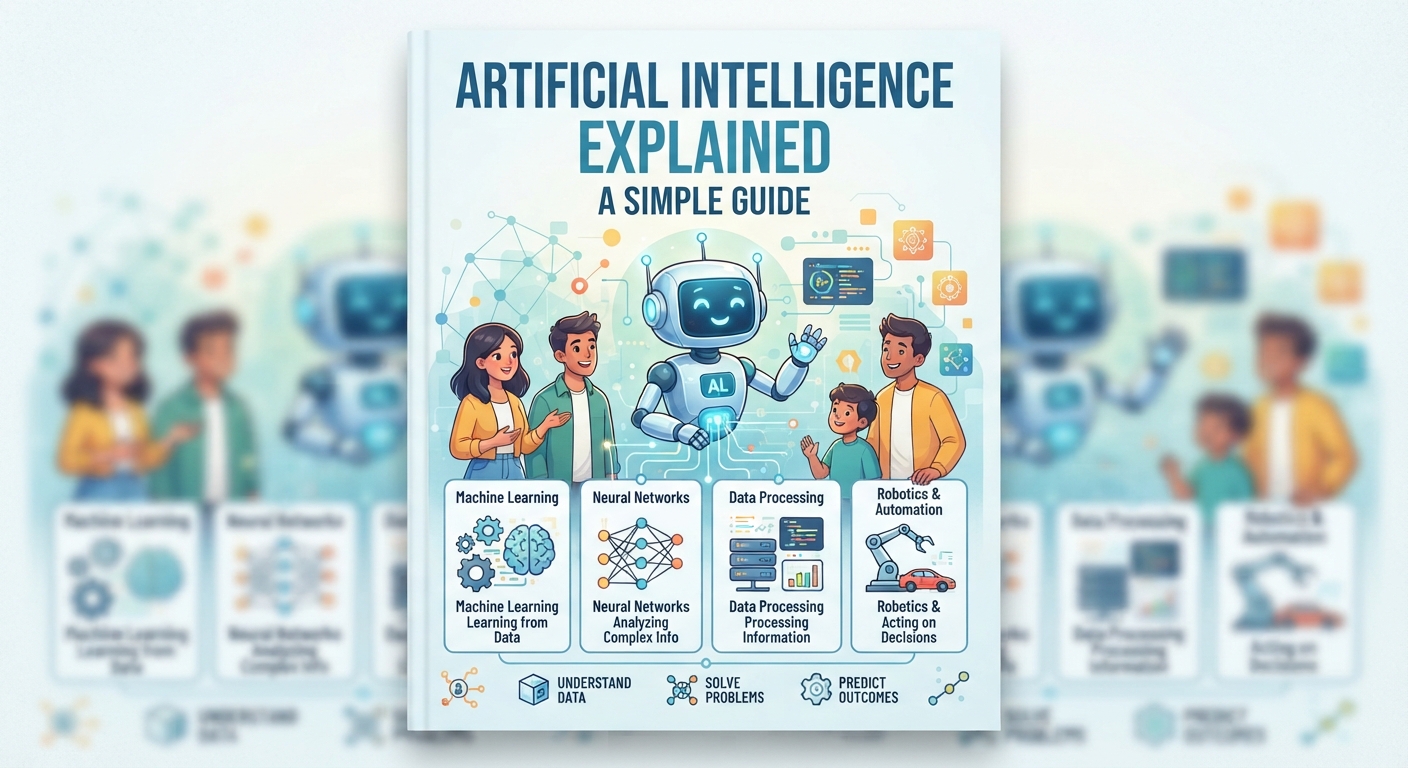
Artificial intelligence is everywhere these days — in your phone, your car, your favorite streaming app, and even in the way your email sorts spam from important messages. Yet for many people, the term still feels vague, technical, and a little intimidating. This guide offers artificial intelligence explained in plain language, so you can understand what it actually is, how it works, and why it matters to your everyday life.
What Is Artificial Intelligence?
At its core, artificial intelligence refers to computer systems designed to perform tasks that normally require human intelligence. These tasks include recognizing speech, understanding language, identifying images, making decisions, and solving problems. Instead of following a single fixed set of instructions, AI systems are built to learn patterns from data and improve their performance over time.
Think of a traditional computer program as a recipe: you give it precise steps, and it follows them exactly, every time. AI, on the other hand, is more like a student. It studies examples, identifies patterns, and gradually gets better at a task the more it practices. This ability to learn and adapt is what separates artificial intelligence from ordinary software.
A Brief History
The idea of intelligent machines isn’t new. Philosophers and mathematicians speculated about “thinking machines” long before computers existed. The formal field of AI research began in the 1950s, when scientists first used the term “artificial intelligence” to describe machines that could simulate human reasoning.
Progress was slow for decades due to limited computing power and data. But over the last fifteen years, three things changed everything: massive increases in computing power, the explosion of available digital data, and breakthroughs in algorithms, especially in a technique called deep learning. Together, these advances turned AI from a niche academic pursuit into one of the most transformative technologies of our time.
How Does Artificial Intelligence Work?
To keep this artificial intelligence explained guide simple, let’s break the process into three basic steps:
- Data Collection – AI systems need large amounts of information to learn from, whether that’s images, text, numbers, or sounds.
- Training – Using this data, the system adjusts its internal parameters through a process called machine learning, gradually improving its ability to recognize patterns and make predictions.
- Inference – Once trained, the AI applies what it has learned to new, unseen situations, generating outputs like answers, recommendations, or classifications.
Most modern AI relies on a subset called machine learning, and within that, a further subset called deep learning, which uses structures loosely inspired by the human brain called neural networks. These networks are made of layers of interconnected nodes that process information step by step, allowing the system to detect increasingly complex patterns.
Types of Artificial Intelligence
When people talk about AI today, they usually mean one of the following categories:
- Narrow AI: Designed to perform a specific task, such as facial recognition, language translation, or product recommendations. This is the only type of AI that currently exists in practical use.
- General AI: A theoretical form of AI that would match human intelligence across virtually any task. This remains a research goal, not a reality.
- Superintelligent AI: A hypothetical future stage where AI would surpass human intelligence in all areas. This concept remains speculative and is often discussed in the context of long-term ethical and safety considerations.
Understanding this distinction is important, because most discussions of “AI taking over” refer to speculative general or superintelligent systems, not the narrow AI tools we actually use today.
Everyday Examples of AI
One of the best ways to grasp artificial intelligence explained simply is to look at where it already shows up in daily life:
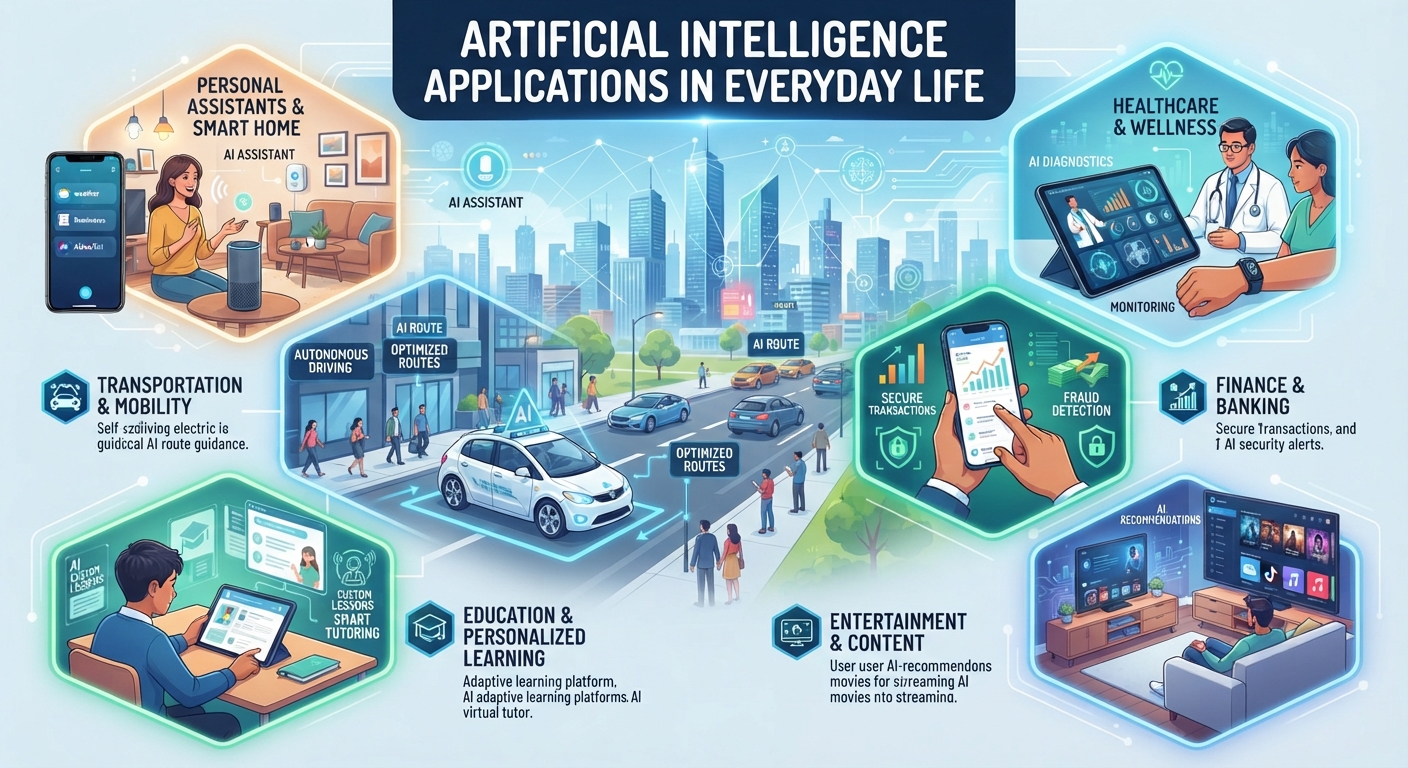
- Voice assistants like Siri and Alexa use natural language processing to understand spoken commands.
- Streaming services such as Netflix and Spotify use AI to recommend shows or songs based on your habits.
- Navigation apps like Google Maps use AI to predict traffic patterns and suggest the fastest routes.
- Email filters use AI to detect and block spam messages.
- Chatbots on websites use AI to answer customer questions instantly.
- Healthcare tools use AI to help doctors detect diseases earlier through image analysis.
These examples show that AI isn’t a distant, futuristic concept — it’s a practical tool already woven into the fabric of modern life.
Why Artificial Intelligence Matters
The significance of AI goes beyond convenience. Businesses use it to improve efficiency, reduce costs, and make better decisions based on data. Governments explore it for public services, from traffic management to disaster response. Researchers use it to accelerate scientific discovery, including drug development and climate modeling.
At the same time, AI raises important questions about privacy, job displacement, bias in decision-making, and the ethical use of automated systems. A responsible approach to AI development involves transparency, fairness, and human oversight, ensuring that these powerful tools benefit society broadly rather than causing harm.
Common Misconceptions About AI
Because AI is often portrayed dramatically in movies and media, several misconceptions persist:
- Myth: AI can think and feel like a human. Reality: AI systems process patterns in data; they don’t have consciousness, emotions, or genuine understanding.
- Myth: AI will soon replace all human jobs. Reality: AI is more likely to change the nature of jobs, automating repetitive tasks while creating new roles focused on managing and improving AI systems.
- Myth: AI is always accurate and unbiased. Reality: AI systems can inherit biases present in their training data, which is why careful design and testing are essential.
Clearing up these misconceptions is a key part of making artificial intelligence explained accessible to a general audience, rather than leaving people with fear-based assumptions drawn from science fiction.
The Future of AI
Looking ahead, AI is expected to become even more integrated into daily life, powering smarter homes, more personalized education, advanced medical diagnostics, and more efficient industries. Researchers continue working toward improving AI’s reasoning abilities, reducing errors, and making systems more transparent and trustworthy.
While the technology will keep evolving, the fundamental goal remains the same: building tools that assist and enhance human capabilities rather than replace human judgment entirely.
Final Thoughts
Hopefully, this guide has made artificial intelligence explained in a way that feels approachable rather than overwhelming. At its heart, AI is simply a set of technologies that allow machines to learn from data and perform tasks that once required human intelligence. From voice assistants to recommendation engines, it’s already shaping how we live and work — and understanding the basics is the first step toward using it wisely and confidently in the years ahead.



Leave a Reply