

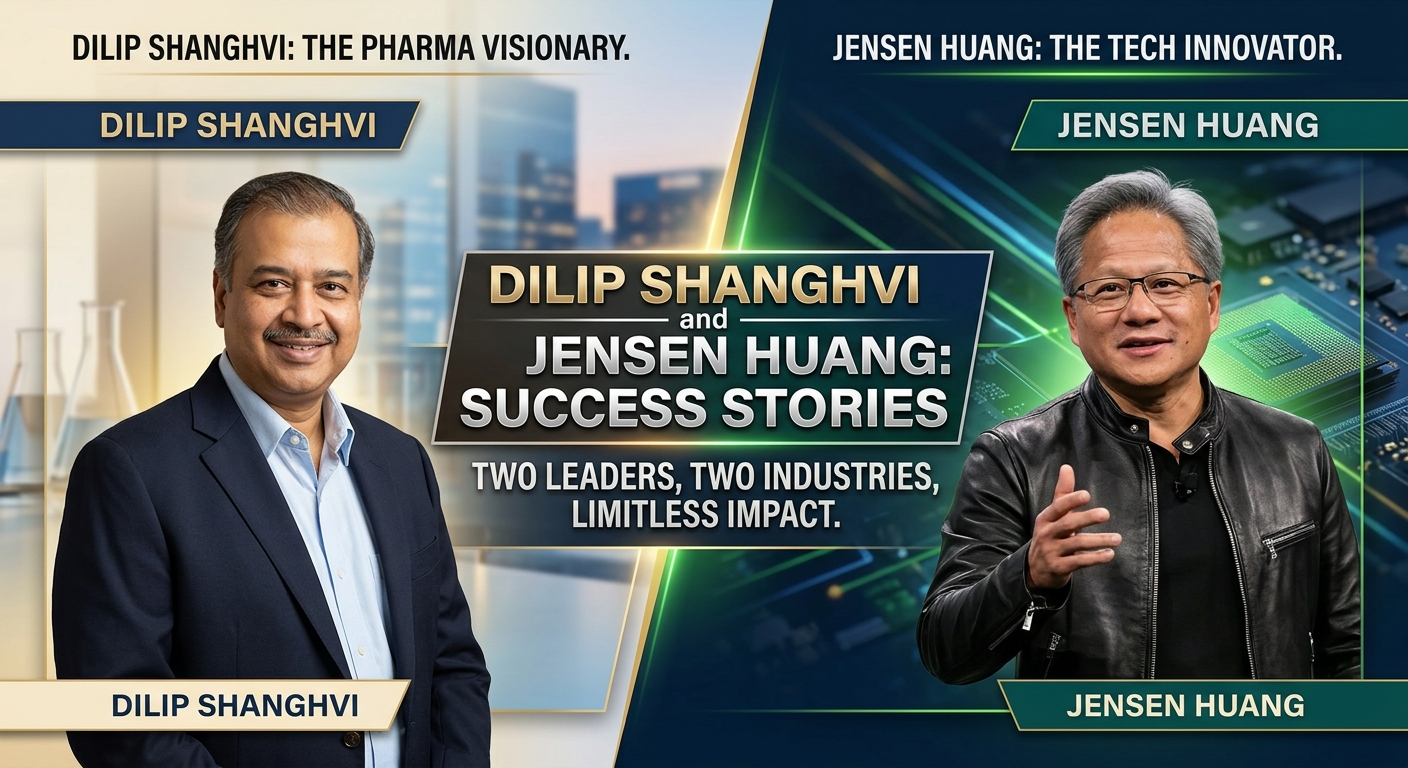
Few business journeys inspire as much as those that begin with limited resources and end with global influence. The stories of Dilip Shanghvi and Jensen Huang show how patience, technical depth, and a willingness to bet on the long term can build companies that change entire industries. One built India’s largest pharmaceutical company, and the other built the company at the center of the artificial intelligence revolution. Though they work in very different fields, their paths share striking similarities.
Dilip Shanghvi: From a Small Loan to Pharma Leadership
Dilip Shanghvi was born in 1955 into a Gujarati business family. His father ran a small pharmaceutical distribution business in Kolkata, so Shanghvi grew up around medicines and trade. He earned a commerce degree and, like many young men of his era, was expected to join the family business.
Instead, he saw a gap in the market. In 1983 he started Sun Pharmaceutical Industries in Vapi, Gujarat, with a modest sum of money borrowed from his father, and a handful of products. His initial focus was on medicines for psychiatric conditions, a niche that larger players were largely ignoring. Specialization was his first strategic insight: rather than competing everywhere, he chose a segment where doctors needed reliable products and competition was thin.
This chronic-therapy focus, covering areas like psychiatry, neurology, and cardiology, gave Sun Pharma a loyal base of prescribing doctors and steady repeat demand. Patients on long-term treatment tend to stay on it, which gave the young company stable revenue even in its early years.
Going Global Through Smart Acquisitions
Shanghvi’s second major move was expanding beyond India. In the late 1990s, Sun acquired a stake in the US-based Caraco Pharmaceutical Laboratories, which gave it a foothold in the world’s largest drug market. Over the following years, the company bought struggling or undervalued businesses and fixed them, building a reputation for turning around acquisitions.
The biggest moment came in 2014 with the acquisition of Ranbaxy, then one of India’s best-known pharmaceutical names but weighed down by regulatory troubles. The deal made Sun Pharma the largest pharmaceutical company in India and among the largest specialty generics players in the world. Critics worried about the risk, but Shanghvi trusted his team’s ability to resolve the quality issues, and he took a patient approach to integration.
Throughout his career, Shanghvi has been known for his low profile. He avoids the spotlight, rarely gives interviews, and lets results speak. Despite becoming one of India’s wealthiest individuals, he is often described as soft-spoken and deeply focused on operations.
Jensen Huang: From Dishwasher to Chip Pioneer
Jensen Huang’s story begins in Taiwan, where he was born in 1963. At around age nine, he was sent with his older brother to the United States and ended up at the Oneida Baptist Institute in Kentucky, a boarding school quite unlike what the family had expected. It was a tough environment, and Huang has spoken about the hardships, including cleaning bathrooms as part of his school duties.
Those experiences shaped his resilience. He went on to study electrical engineering at Oregon State University and later earned a master’s degree at Stanford. He worked at chip companies AMD and LSI Logic, learning the semiconductor business from the inside.
Founding Nvidia at a Diner
In 1993, Huang co-founded Nvidia with Chris Malachowski and Curtis Priem. The founding is now legendary: the three men met at a Denny’s restaurant in California to plan the company. Their idea was that graphics processing would become central to computing, particularly for video games.
The early years were far from smooth. Nvidia nearly ran out of money more than once, and its first product did not succeed. Huang has often said the company survived by moving fast and learning from mistakes. In 1999, the company introduced the GeForce 256, marketed as the world’s first GPU, and it established Nvidia as a leader in graphics.
The CUDA Bet and the AI Boom
Huang’s most important decision may have been investing in CUDA, a software platform released in 2006 that let developers use graphics chips for general-purpose computing. For years, investors questioned the spending, since the payoff was unclear. But when researchers discovered that GPUs were ideal for training neural networks, Nvidia was perfectly positioned. As AI became a global priority, demand for its chips soared, and the company grew into one of the most valuable in the world.
Huang’s trademark leather jacket and hands-on style have made him one of the most recognizable CEOs in technology. He is known for running a flat organization and staying deeply involved in technical details.
What Connects These Two Journeys
Looking at Dilip Shanghvi and Jensen Huang together reveals several common threads that any aspiring entrepreneur can learn from.
1. Start with a focused niche. Shanghvi began with specialty psychiatric medicines, while Huang began with graphics for gaming. Neither tried to be everything to everyone at the start. They mastered a narrow area first, then expanded.
2. Take long-term bets. Shanghvi’s expansion into the US and his purchase of Ranbaxy required patience and courage. Huang’s CUDA investment took years to pay off. Both leaders accepted short-term skepticism in pursuit of long-term advantage.
3. Be resilient through setbacks. Sun Pharma faced regulatory challenges and integration difficulties, and Nvidia faced near-bankruptcy and market downturns. Both men treated difficulty as part of the process rather than a reason to stop.
4. Stay close to the product. Neither leader drifted away from the substance of his business. Shanghvi’s understanding of pharmaceuticals and Huang’s engineering background kept them grounded in what customers actually needed.
5. Build strong teams. Both companies succeeded because of talented people, and both leaders have credited their teams frequently.
Lessons for Entrepreneurs
The shared story of Dilip Shanghvi and Jensen Huang offers practical lessons. First, you do not need massive capital to begin; Shanghvi started with a small loan, and Huang started with an idea and two co-founders. Second, identify where an industry is heading, not just where it stands today. Huang saw that parallel computing would matter, and Shanghvi saw the value of chronic therapies. Third, be willing to be misunderstood for a while. Both men pursued strategies that others doubted.
Finally, humility matters. Both leaders speak openly about luck, timing, and the contributions of others, which keeps their organizations focused and adaptable.
Conclusion
The success stories of Dilip Shanghvi and Jensen Huang remind us that greatness rarely arrives overnight. One built a pharmaceutical giant from a small Gujarat factory, and the other built a technology powerhouse from a diner booth. Their careers prove that discipline, vision, and persistence can overcome humble beginnings, and that the most valuable companies are often built by people willing to commit to a difficult idea long before the world agrees with them.
READ ALSO: https://aimodern.co.uk












Leave a Reply