

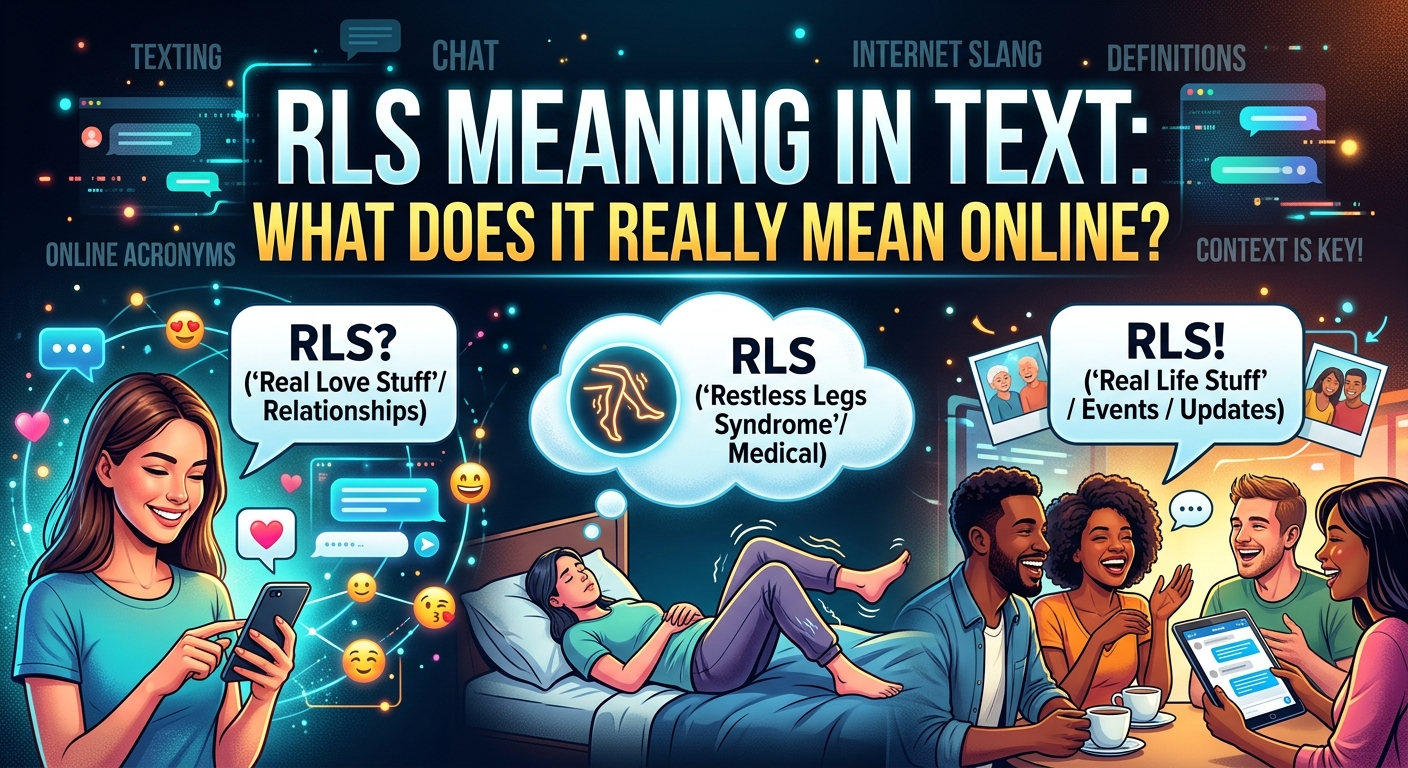
You’re scrolling through a group chat or a comment section when you spot three letters that stop you cold: “RLS.” Is it a typo? A new slang term? Something technical? You’re not alone in wondering. Abbreviations spread fast online, and many of them have more than one meaning. This guide explains the rls meaning in text, where you’re likely to see it, and how to work out which meaning applies.
The Short Answer
In casual texting and social media, RLS most commonly stands for “really.” It’s a quick, lazy-thumb shortcut, much like “pls” for “please” or “thx” for “thanks.” Someone might write “that movie was rls good” or “are you rls going to the party?”
That said, RLS isn’t a universal, standardized abbreviation. Unlike “LOL” or “BRB,” it has no single official definition, and its meaning depends heavily on who is typing, what platform they’re on, and what the conversation is about.
The Most Common Meanings of RLS
1. Really
This is the meaning you’ll run into most often in everyday messaging. Texters drop vowels all the time to type faster, so “really” becomes “rlly,” “rly,” or “rls.” It’s typically used for emphasis or to express surprise:
- “I’m rls tired today.”
- “Rls? You got the job?”
- “That’s rls funny.”
Because it’s informal, you’ll mostly see it in chats between friends, on Snapchat, in Instagram comments, and in other relaxed spaces.
2. Real Life
Some people use RLS as shorthand for “real life,” usually when contrasting online and offline experiences. For example: “He’s so different in RLS compared to his online persona.” Most people still write “IRL” (“in real life”) for this, but RLS appears occasionally, especially in gaming and forum communities.
3. Restless Legs Syndrome
Outside of slang, RLS is a well-known medical abbreviation for restless legs syndrome, a neurological condition that causes an uncomfortable urge to move the legs, often in the evening or at night. If you see RLS in a health forum, a sleep-related discussion, or a message about doctors and symptoms, this is almost certainly what it means. Someone writing “my RLS is acting up again, can’t sleep” is talking about the condition, not slang.
4. Row-Level Security
In tech and software circles, RLS refers to row-level security, a database feature that controls which users can see which rows of data. You’ll find it in discussions of databases like PostgreSQL or Microsoft SQL Server. If the conversation involves developers, permissions, or data access, this is the likely meaning.
5. Gaming and Niche Uses
In gaming communities, RLS can also be shorthand for a specific game, release, or in-group term. These uses vary from community to community and are rarely documented, so the surrounding conversation is your best clue.
How to Figure Out What RLS Means in Context
Since the abbreviation has several meanings, a few simple checks can help you decode it.
Look at the topic. A chat about health points to restless legs syndrome. A chat about coding points to row-level security. A casual chat about weekend plans almost always means “really.”
Check the sentence structure. If RLS sits where an adverb would normally go (“I’m rls excited”), it almost certainly means “really.” If it works as a noun (“I have RLS”), it’s likely the medical or technical meaning.
Consider the platform. TikTok, Snapchat, and text messages lean toward slang. LinkedIn, medical forums, and developer communities lean toward formal abbreviations.
Notice the tone. Lowercase, relaxed, and surrounded by emojis usually signals slang. Capitalized and formal usually signals a technical or medical term.
When in doubt, ask. There’s no shame in replying, “Wait, what does RLS mean here?” Language online changes constantly, and most people are happy to explain.
Why Texting Abbreviations Keep Multiplying
Abbreviations like RLS exist because people value speed and personality in digital communication. Typing on a phone is slower than speaking, so we cut letters, merge words, and invent shortcuts. Slang also builds a sense of belonging: using the same shorthand as your friends signals that you’re part of the same group.
The downside is ambiguity. Because many abbreviations are created organically rather than defined by any authority, one set of letters can end up meaning several unrelated things. “RLS” is a perfect example. It can be a casual intensifier, a medical condition, or a database feature, depending entirely on who’s talking.
Should You Use RLS Yourself?
If you want to use RLS to mean “really,” keep a few things in mind:
- Know your audience. Friends your age will probably get it, but older relatives or coworkers might not.
- Keep it casual. Don’t use it in emails to your boss, school assignments, or professional messages.
- Avoid confusion. If your message could be read as the medical or technical meaning, spell out “really.”
- Consider alternatives. “Rly,” “rlly,” and “really” are more widely recognized, so they’re safer if you want to be understood.
Quick Reference Table
| Meaning | Where You’ll See It | Example |
|---|---|---|
| Really | Texts, social media, DMs | “That’s rls cool.” |
| Real life | Gaming, forums | “He’s quieter in RLS.” |
| Restless legs syndrome | Health discussions | “My RLS keeps me up.” |
| Row-level security | Tech and database talk | “Enable RLS on the table.” |
Final Thoughts
Decoding the rls meaning in text comes down to context. In everyday chats, it’s most likely a shortened “really.” In health conversations, it points to restless legs syndrome, and in tech spaces, it refers to row-level security. Pay attention to the topic, the platform, and the way the abbreviation is used in the sentence, and you’ll rarely be confused for long.
Slang will keep evolving, and new abbreviations will keep appearing in your feed. When you meet one you don’t recognize, a quick look at the context or a polite question is usually all it takes to stay in the loop.
READ ALSO: https://aimodern.co.uk









Leave a Reply