

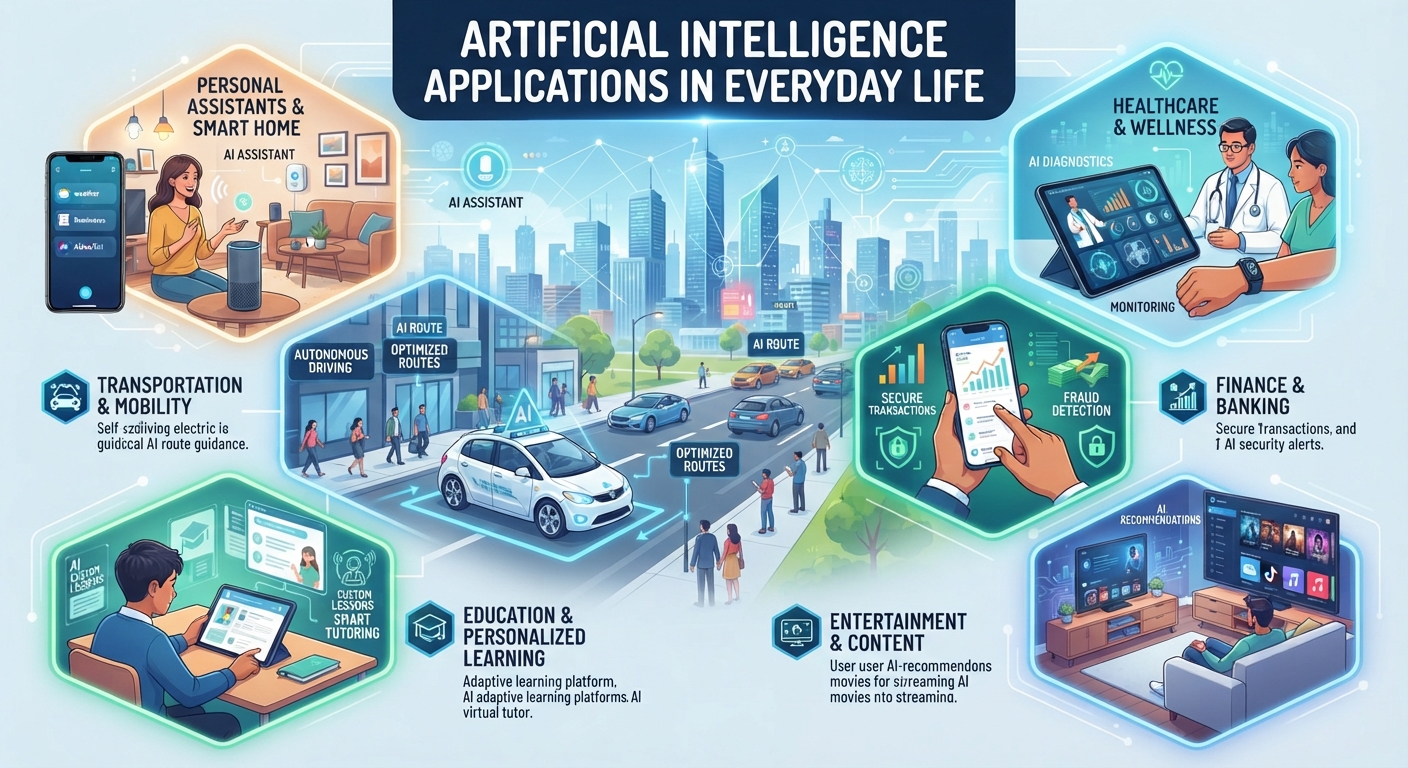
Artificial intelligence has quietly moved from research labs into the fabric of daily routines. What once sounded like science fiction is now embedded in the phones we carry, the cars we drive, and the homes we live in. Understanding the many artificial intelligence applications shaping modern life helps explain why this technology has become impossible to ignore, and why it continues to grow at such a rapid pace.
AI in Smartphones and Personal Devices
The most familiar artificial intelligence applications are the ones people interact with dozens of times a day without even realizing it. Voice assistants like Siri, Alexa, and Google Assistant rely on natural language processing to understand spoken commands, answer questions, and control smart devices. Smartphone cameras use AI to automatically adjust lighting, detect faces, and enhance photo quality in real time. Predictive text and autocorrect features learn from typing habits to suggest words before a sentence is even finished. These small but constant conveniences show how deeply intelligent systems have integrated themselves into personal technology.
Smart Homes and Connected Living
Homes are becoming smarter thanks to a growing range of AI-powered devices. Smart thermostats learn a household’s temperature preferences and adjust heating or cooling automatically to save energy. Security cameras use facial recognition and motion detection to distinguish between family members, visitors, and potential intruders. Robotic vacuum cleaners map out living spaces and navigate around obstacles with increasing precision. Together, these tools represent some of the most practical artificial intelligence applications available to ordinary consumers, turning houses into responsive, efficient living environments.
Transportation and Navigation
Getting from one place to another has also been transformed by intelligent systems. Navigation apps such as Google Maps and Waze use machine learning to analyze traffic patterns, predict delays, and suggest the fastest routes in real time. Ride-sharing platforms rely on algorithms to match drivers with passengers efficiently and to set dynamic pricing based on demand. Meanwhile, self-driving car technology, though still evolving, showcases how far AI has come in interpreting complex, real-world environments. These developments highlight how transportation-related artificial intelligence applications are reshaping mobility for millions of people every day.
Healthcare and Wellness
The healthcare sector has embraced AI to improve diagnosis, treatment, and patient care. Wearable fitness trackers monitor heart rate, sleep patterns, and activity levels, using algorithms to offer personalized health insights. AI-powered diagnostic tools help doctors detect diseases like cancer or diabetic retinopathy from medical images with remarkable accuracy. Chatbots and virtual health assistants provide preliminary symptom checks, easing the burden on healthcare systems. As these tools become more sophisticated, the role of artificial intelligence applications in healthcare continues to expand, offering earlier detection and more personalized treatment plans.
Online Shopping and Personalized Recommendations
E-commerce platforms have become remarkably good at predicting what customers want. Retailers like Amazon and streaming services like Netflix and Spotify use recommendation engines powered by machine learning to analyze browsing history, purchase patterns, and viewing habits. This allows them to suggest products, movies, or songs tailored to individual preferences. Chatbots on shopping websites handle customer service inquiries instantly, while dynamic pricing algorithms adjust costs based on demand and inventory. These uses demonstrate how businesses leverage data-driven intelligence to create more personalized and efficient customer experiences.
Finance and Banking
The financial industry relies heavily on AI to detect fraud, assess risk, and automate routine tasks. Banks use machine learning algorithms to monitor transactions and flag unusual activity that might indicate fraudulent behavior. Robo-advisors offer automated investment advice based on a person’s financial goals and risk tolerance, making wealth management more accessible. Credit scoring models increasingly incorporate AI to evaluate loan applications more accurately and quickly. Such financial tools are among the more consequential artificial intelligence applications, as they directly affect people’s economic security and access to services.
Education and Learning
Education has also benefited from AI-driven innovation. Adaptive learning platforms adjust the difficulty of lessons based on a student’s performance, helping them learn at their own pace. Automated grading systems save teachers time by evaluating multiple-choice and even some written assignments. Language learning apps like Duolingo use AI to personalize practice sessions and track progress. These tools make education more accessible and tailored to individual needs, particularly for students who require extra support or flexible learning schedules.
Workplace Productivity
In professional settings, AI tools are streamlining workflows and boosting efficiency. Email platforms use spam filters and smart categorization to manage inboxes. Virtual meeting assistants can transcribe conversations, summarize key points, and even schedule follow-up tasks automatically. Customer service departments increasingly rely on AI chatbots to handle routine inquiries, freeing human employees to focus on more complex issues. As remote and hybrid work becomes more common, these productivity-focused tools are proving essential for keeping teams organized and connected.
Entertainment and Social Media
Social media platforms and entertainment services use AI extensively to curate content feeds. Algorithms analyze user behavior to determine what posts, videos, or advertisements are most likely to capture attention. Photo and video editing apps use AI filters to enhance images or generate creative effects with a single tap. Gaming companies also use AI to create more realistic non-player characters and adaptive difficulty levels, making games more engaging and responsive to individual play styles.
Challenges and Considerations
Despite their benefits, widespread AI adoption raises important questions about privacy, data security, and job displacement. As algorithms collect and analyze vast amounts of personal information, concerns about how that data is used and protected have grown. There are also ongoing debates about bias in AI systems, particularly when they influence decisions in hiring, lending, or law enforcement. Addressing these challenges responsibly will be essential as intelligent technologies continue to expand into new areas of daily life.
Conclusion
From smartphones to hospitals, from online shopping to classrooms, artificial intelligence applications have become deeply woven into the way people live, work, and interact with the world. This technology continues to make daily tasks more efficient, personalized, and convenient, while also raising important ethical and practical questions that society must address. As AI continues to evolve, its presence in everyday life is likely to deepen further, making it one of the most transformative technologies of our time.




Leave a Reply