

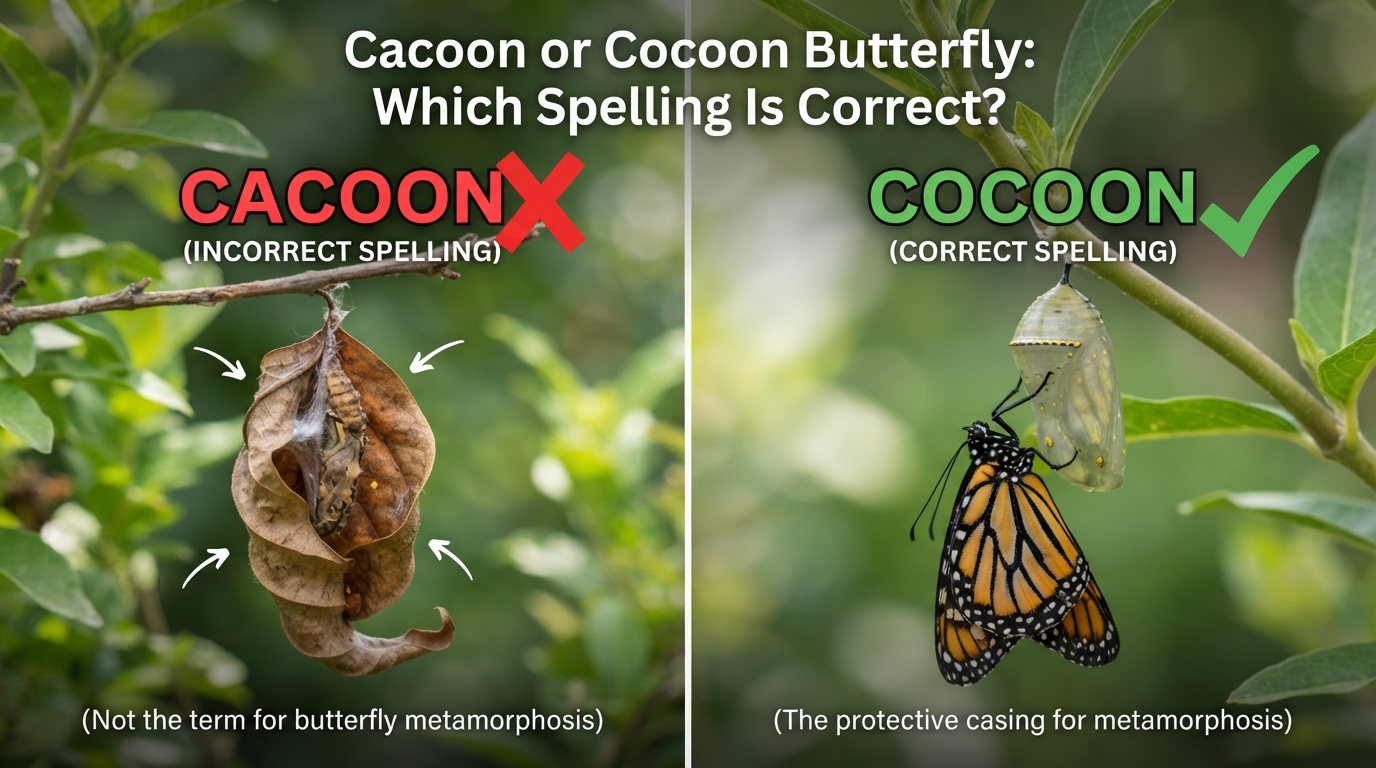
If you’ve ever watched a caterpillar transform into a butterfly, you’ve probably wondered about the correct name for that silky protective case. A quick search online reveals two spellings floating around: “cacoon” and “cocoon.” So when people ask about cacoon or cocoon butterfly, which one is actually correct? Let’s settle this spelling debate once and for all.
The Short Answer
The correct spelling is cocoon, not “cacoon.” When discussing insect metamorphosis, cocoon is the only accepted spelling in standard English dictionaries, scientific literature, and everyday usage. “Cacoon” is a common misspelling that likely results from mixing up vowel sounds or confusing it with similar-sounding words like “cacao” or “raccoon.”
So, whenever you’re debating cacoon or cocoon butterfly in your writing, remember: cocoon wins every time.
Why Does the Confusion Happen?
English spelling can be tricky, and many words don’t follow intuitive phonetic rules. Here are a few reasons people mix up “cacoon” and “cocoon”:
- Similar-sounding words: Words like “raccoon” and “cacao” share sound patterns with “cocoon,” which can cause people to blend the spellings in their heads.
- Regional pronunciation: Depending on accent or dialect, the vowel sounds in “cocoon” might come across differently, leading some to write it phonetically as “cacoon.”
- Typing errors: Simple typos are common, especially when typing quickly or using voice-to-text software that misinterprets the word.
- Lack of familiarity: Not everyone regularly encounters entomology or biology terms, so when the word cocoon comes up, some writers guess at the spelling rather than checking it.
Interestingly, there actually is a word “cacoon” — but it has nothing to do with butterflies. It refers to a type of large seed pod from certain tropical vines, sometimes used to make jewelry or containers. This obscure botanical term is part of why the confusion persists, even though it’s rarely used in everyday conversation.
What Exactly Is a Cocoon?
Now that we’ve clarified the spelling, let’s talk about what a cocoon actually is. A cocoon is a protective casing that certain insects—most notably moths—spin around themselves during the pupal stage of metamorphosis. It’s typically made of silk, which the larva produces from special glands before it transforms into an adult insect.
Here’s an important distinction many people miss: not all butterflies make cocoons. In fact, most butterflies form a chrysalis, which is a hard, smooth protective shell that develops from the caterpillar’s own skin, without any silk wrapping. Moths, on the other hand, are the primary cocoon-spinners, using silk threads to build a soft, fibrous casing around their pupae.
This means that technically, the phrase “cacoon or cocoon butterfly” is a bit of a misnomer for most species, since butterflies usually pupate inside a chrysalis rather than a true cocoon. However, the terms are often used interchangeably in casual conversation, and many people search for cacoon or cocoon butterfly simply because they’re trying to understand the general transformation process, regardless of the precise biological term.
Cocoon vs. Chrysalis: A Quick Breakdown
| Feature | Cocoon | Chrysalis |
|---|---|---|
| Made by | Moths (mostly) | Butterflies |
| Material | Silk threads | Hardened caterpillar skin |
| Texture | Soft, fuzzy, fibrous | Smooth, hard shell |
| Location | Often hidden in leaves or bark | Frequently exposed, hanging |
Understanding this difference can help clear up a lot of confusion for students, nature enthusiasts, and parents helping kids with science homework.
How to Remember the Correct Spelling
If you want a simple trick to avoid misspelling this word in the future, try this: think of the double “o” in “cocoon” as representing the two rounded ends of the silky casing itself. Visualizing the shape of the word alongside the shape of the actual cocoon can help cement the correct spelling in your memory.
Another helpful method is to associate “cocoon” with other common “-oo-” words like “balloon,” “raccoon,” or “spoon.” Since these words are spelled with a double “o” in the middle, it reinforces the pattern and makes “cacoon” feel obviously wrong by comparison.
Why Correct Spelling Matters
You might wonder why something as small as a single letter matters so much. In casual conversation, minor misspellings might not seem like a big deal. However, in academic writing, published articles, or professional content, using the wrong spelling can undermine your credibility. If you’re a student writing a biology report, a blogger covering nature topics, or a content creator producing educational material, getting basic terminology right builds trust with your audience.
Additionally, search engines and readers alike expect standard spelling. If you consistently search for cacoon or cocoon butterfly online, you’ll notice that most educational and scientific sources use “cocoon” exclusively, reinforcing that this is the accepted standard.
Final Thoughts
To wrap up the debate around cacoon or cocoon butterfly, remember that “cocoon” is the correct and widely accepted spelling. “Cacoon” is a misspelling, though it does exist as an unrelated word referring to certain tropical seed pods. Also, keep in mind that most butterflies actually form a chrysalis rather than a true cocoon, while moths are the primary creators of silk cocoons.
Next time you’re writing about insect metamorphosis, you can confidently use “cocoon” and know you’re using the scientifically accurate and grammatically correct term. Whether you’re crafting a school report, a blog post, or simply satisfying your curiosity about nature, getting this small but important detail right will make your writing clearer and more credible.












Leave a Reply