

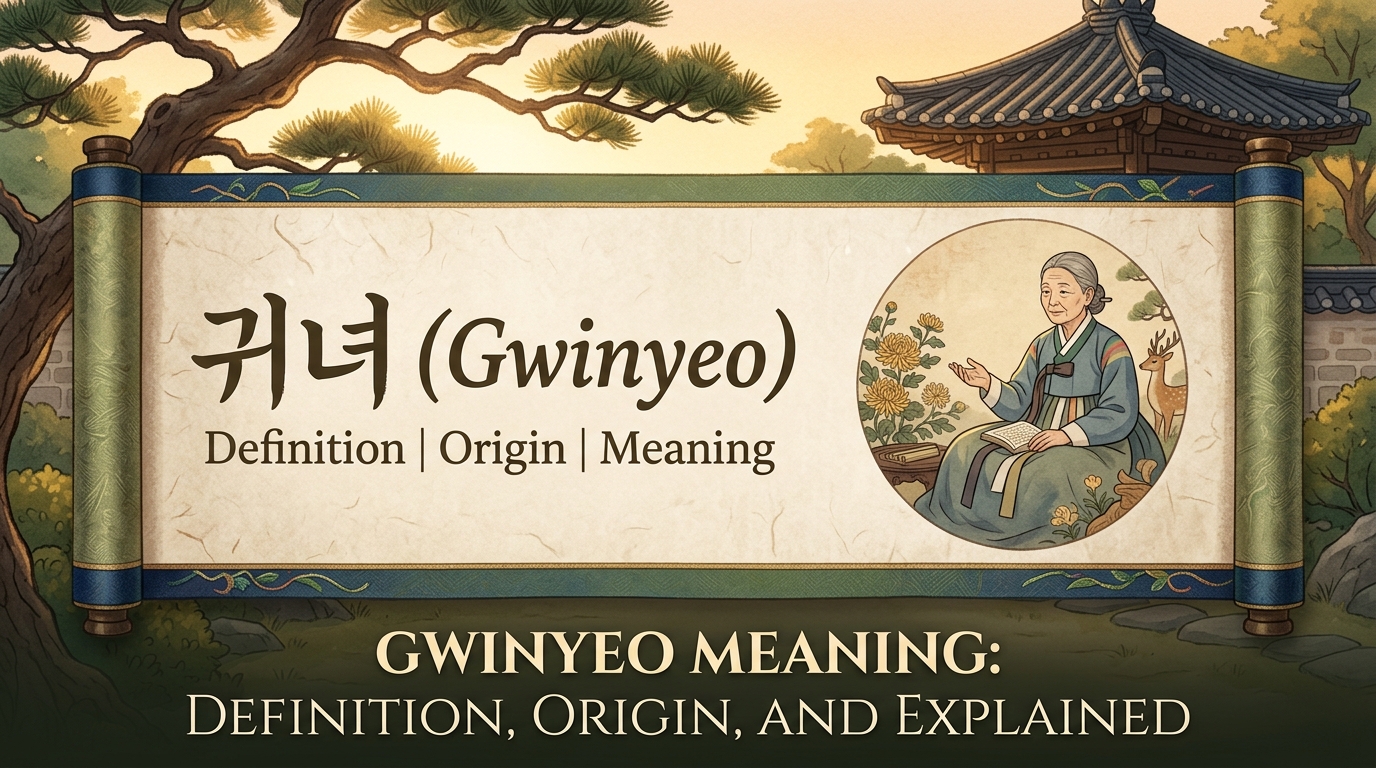
Korean historical dramas, webtoons, and novels are full of words that sound beautiful but are rarely translated well. “Gwinyeo” is one of them. Fans often meet it in subtitles or character names and wonder what it really signifies. This article explains the word’s definition, its roots in Korean and Sino-Korean vocabulary, and how it is used today.
What Does Gwinyeo Mean in Practice?
“Gwinyeo” is the romanized form of the Korean word 귀녀. In its most common sense, it translates to “noble lady” or “honorable woman.” It describes a woman of high birth, elevated social standing, or refined character. In historical settings, it can also work as a respectful way of referring to a woman of rank.
The word has two parts:
- Gwi (귀) carries the idea of “precious,” “valued,” or “noble.”
- Nyeo (녀), sometimes written “yeo” at the start of a word, means “woman” or “female.”
Put together, they describe a woman who is esteemed, whether through family, position, or manner. Context matters, though. As with many Korean terms, tone and setting shape how the word lands. In a period drama it may sound formal and courteous. In a modern story it may feel poetic, archaic, or even ceremonial.
Understanding the Definition More Deeply
Korean vocabulary is built on three layers: native Korean words, Sino-Korean words (borrowed from Chinese characters, or hanja), and loanwords from other languages. “Gwinyeo” belongs to the Sino-Korean layer. This matters because Sino-Korean words tend to feel more formal, literary, and elevated than native Korean words. They are the vocabulary of scholars, officials, and written records.
Many Sino-Korean terms combine one syllable meaning a quality with one meaning a type of person. You can see the same pattern in other words:
- Gwiin (귀인) means “noble person” or “distinguished person.”
- Yeoin (여인) is a literary word for “woman.”
- Sonyeo (소녀) means “girl.”
Seen this way, 귀녀 is a natural compound. It follows the same grammatical pattern as other respectful titles, which is why it feels familiar to Korean speakers even when it is uncommon in everyday speech.
The Origin of the Word
The roots of “gwinyeo” lie in the influence of classical Chinese on the Korean language. For many centuries, Korea’s educated class wrote in Chinese characters, and Korean absorbed a large portion of its formal vocabulary from them. The hanja most often associated with 귀녀 is 貴女: 貴 (valuable, noble) and 女 (woman). The same characters appear in Chinese and Japanese, where they form a similar compound meaning a noble or high-born woman.
In Joseon-era Korea (1392–1897), social hierarchy shaped nearly every aspect of life, including language. Titles and honorifics signaled rank, and words like 귀녀 fit into a rich system of respectful terms for people of different standing. They appeared in literature, poetry, and storytelling, often idealizing graceful, high-born women.
Terms like this often survive long after the social structures that produced them. Today they are kept alive mainly through historical dramas, fantasy fiction, and creative works that want an old-world atmosphere.
A Note on Another Possible Meaning
Korean has many homophones. Because the language uses the same sound for different hanja, 귀녀 can occasionally correspond to 鬼女, meaning a “ghost woman” or “female spirit.” This usage appears in folklore, horror, and supernatural storytelling. The two meanings are very different, which is why context is essential. If you see “gwinyeo” in a romance or palace drama, “noble lady” is almost certainly intended. If it appears in a ghost story or a title involving spirits, the supernatural reading becomes more likely.
When in doubt, check the original Korean spelling or hanja if the source provides it. The characters remove the ambiguity.
How the Word Appears in Modern Culture
In contemporary Korean, you will rarely hear 귀녀 in casual conversation. Nobody greets a friend with it. Instead, it appears in specific settings:
- Historical dramas (sageuk): Characters may refer to a high-born woman using respectful, period-appropriate language.
- Webtoons and web novels: Fantasy and romance stories set in noble courts often use the term to set the tone.
- Character names and titles: Writers and game designers sometimes choose it for characters meant to feel dignified, mysterious, or aristocratic.
- Literary and poetic writing: Authors use it to evoke elegance and tradition.
For international fans, translation choices vary. Subtitlers may render the word as “noble lady,” “milady,” “young mistress,” or simply “lady,” depending on the scene. These choices are interpretations, not exact matches, which is one reason people search for the original term.
Why the Meaning Matters
Understanding a word like this goes beyond vocabulary. It shows how Korean culture has historically linked language with social order and respect. The word is not only a label. It carries ideas about dignity, upbringing, and how society viewed women of status.
It also shows how language changes. A word that once belonged to everyday court and aristocratic life has become a stylistic tool in modern storytelling. Writers use it not because it is common, but because it feels rich with history.
Tips for Learners
If you are studying Korean or just enjoy Korean media, a few habits will help with words like this:
- Learn the hanja roots. Recognizing 貴 and 女 helps you decode many other words.
- Check the context. Genre often tells you which meaning is intended.
- Compare translations. Seeing how different subtitlers handle the word reveals its shades of meaning.
- Notice formality. Sino-Korean terms usually signal a formal or literary register.
Final Thoughts
In short, gwinyeo mean is best understood as “noble lady” or “honorable woman,” built from Sino-Korean roots that express value and femininity. It is an elegant, formal term that has largely moved from daily life into historical storytelling, fantasy, and literature. Its occasional homophone, meaning a female ghost, is a reminder that Korean always rewards attention to context.
Whether you met the word in a drama, a webtoon, or a character name, knowing its definition and origin lets you appreciate the story with a little more depth.
READ ALSO: https://aimodern.co.uk













Leave a Reply