


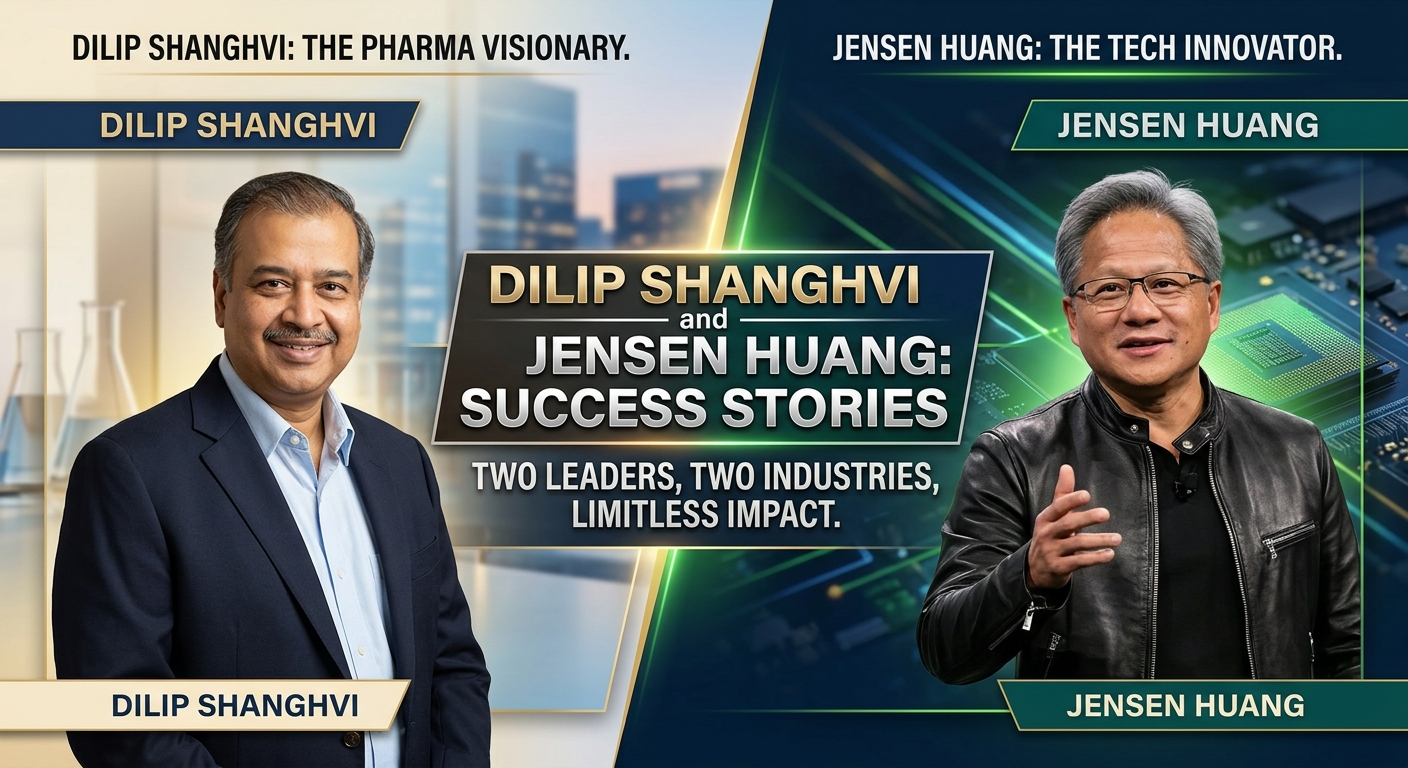
Two founders, two continents, two very different industries. One built a pharmaceutical empire from a small start in Kolkata, and the other reshaped computing from a booth in a roadside diner. Looking at dilip shanghvi and jensen huang side by side shows how differently great companies can grow, and what the best of them share.
Two Origin Stories
Dilip Shanghvi grew up in Amreli, Gujarat, in a family of pharmaceutical traders. He studied commerce and joined his father’s wholesale drug business. In 1983 he founded Sun Pharmaceutical Industries with a small loan from his father and a handful of products, mostly psychiatric medicines. The company targeted a real gap in the Indian market: reliable, affordable drugs for chronic conditions.
Jensen Huang grew up in Tainan, Taiwan, and moved to the United States as a child. He studied electrical engineering at Oregon State University, earned a master’s at Stanford, and worked at LSI Logic and AMD. In 1993 he co-founded Nvidia with Chris Malachowsky and Curtis Priem. The founders held their early meetings at a Denny’s restaurant in San Jose. Their bet was that graphics chips would become central to personal computing.
Both men began with modest resources and a focused idea. Neither had a large war chest, and both survived many lean years.
Industries With Different Rules
Their industries reward different strengths.
Pharmaceuticals demand heavy regulation, large capital, and patience. A new drug can take a decade to develop, and generic manufacturers compete on cost, quality, and regulatory compliance. Operational discipline matters more than speed. Sun Pharma’s early growth came from doing hard, unglamorous things well: consistent manufacturing, careful cost control, and a reputation for quality.
Semiconductors and AI computing move at a punishing pace. Product cycles run short, and a missed architectural shift can kill a company. Nvidia nearly collapsed in its early years after a disappointing first product, and Huang has spoken openly about how close it came. The company survived by shipping quickly and backing the right technology at the right moment.
Growth Strategy: Acquisition vs. Platform
The clearest difference lies in how each company grew.
Shanghvi’s signature move has been acquisition. In the 1990s Sun Pharma bought a controlling stake in Caraco Pharmaceutical Laboratories, which gave it an early foothold in the American generics market. It later acquired Taro Pharmaceutical after a long and contentious process, and in 2014 it bought Ranbaxy in a deal worth around $4 billion. That deal made Sun Pharma India’s largest pharmaceutical company and one of the biggest specialty generics players in the world. Shanghvi often buys troubled or undervalued businesses and repairs them. He has also steered Sun toward specialty and branded products in dermatology and other areas.
Huang chose an organic, platform-driven path. Nvidia introduced the GeForce 256 in 1999 and marketed it as the world’s first GPU. Its most consequential decision came in 2006, when it launched CUDA, a software platform that lets developers use GPUs for general-purpose computing. For years CUDA looked like an expensive distraction. Then deep learning took off, researchers discovered that GPUs suit neural network training perfectly, and Nvidia already had the hardware, the software, and a developer ecosystem ready. Acquisitions such as Mellanox in 2020 added to the platform, but the core strategy remained a moat built on software and ecosystem lock-in.
Leadership Style and Public Image
The personal contrast is just as striking. Shanghvi keeps a famously low profile. He rarely gives interviews, avoids the spotlight, and lives simply despite ranking among India’s wealthiest people. His authority comes from the quiet consistency of his decisions and his reputation for keeping his word with investors, partners, and employees.
Huang, by contrast, ranks among the most visible executives in the world. Audiences treat his keynote presentations like product launches, his black leather jacket has become a trademark, and he embraces his role as the public face and chief evangelist of Nvidia. He has run the company for more than three decades, a rare tenure in Silicon Valley. He favors a flat management structure and stays involved in technical details.
Their styles differ, but both men stayed in the top job for decades and kept a long-term view while competitors chased short-term results.
The Scale of Success
Both companies have created enormous value, though at different magnitudes. Sun Pharma operates as a multi-billion-dollar global business with a presence in more than 100 countries. Nvidia’s rise has been steeper. Demand for AI infrastructure pushed it to the top tier of the world’s most valuable companies, and its market capitalization has passed the multi-trillion-dollar mark. The difference reflects the industries. Software-and-silicon platforms can scale explosively when a technology wave hits, while pharmaceutical growth tends to be steadier because regulation and pricing constrain it.
Risks Each Faces
Neither company escapes challenges. Sun Pharma must navigate U.S. generic price erosion, regulatory inspections, and the long, uncertain path of specialty drug development. Nvidia faces intense competition from rivals and from its own largest customers, who build custom chips. Export controls, geopolitical tension around Taiwan-based manufacturing, and the possibility that AI spending cools add further pressure. Both founders have weathered setbacks before, and how they handle the next ones will shape their legacies.
Lessons for Entrepreneurs
The story of dilip shanghvi and jensen huang offers several lessons that apply well beyond pharma or chips:
- Start with a real gap. Sun filled a need for chronic-care medicines, and Nvidia saw that graphics would matter more than most people expected.
- Play the long game. Ranbaxy’s integration and CUDA’s slow payoff both demanded years of patience.
- Build advantages that compound. Sun’s manufacturing and regulatory expertise and Nvidia’s developer ecosystem give competitors little to copy easily.
- Stay close to the core. Both leaders remain deeply involved in their businesses, not just their balance sheets.
- Style is flexible, substance is not. A quiet operator and a showman can both lead great companies if the strategy and execution hold up.
Conclusion
Comparing dilip shanghvi and jensen huang shows that no single template exists for building a world-class company. One expanded through disciplined acquisitions and operational rigor in a regulated industry, and the other through relentless technical innovation and ecosystem building in a fast-moving one. One avoids attention, and the other welcomes it. Yet both started small, chose a clear opportunity, endured hard years, and kept leading for decades. For anyone building a business, that shared persistence may be the most important lesson of all.











Leave a Reply